


The Role of Coronal Access in Modern Zygoma Reduction Surgery
Why Advanced Craniofacial Surgeons Are Reconsidering the Coronal Approach
Facial contouring surgery has evolved substantially over the past two decades, particularly in East Asian craniofacial aesthetic surgery where zygoma reduction remains one of the most technically demanding procedures. While intraoral malar reduction techniques gained popularity because they avoid visible scalp incisions, long-term outcome analysis increasingly demonstrates biomechanical and aesthetic limitations associated with limited surgical exposure.
Recent literature, especially the landmark work by Jae-Yoon Seol and Kenneth K. Kim, has reignited interest in the coronal approach as a superior method for achieving stable, anatomically favorable, and aesthetically refined zygomatic reduction.

Fig. 1. The intraoral approach limits access to the medial aspect of the zygoma so only a lat-
eral osteotomy can be performed. The lateral osteotomy of the intraoral approach creates
a sharp angle of the zygomatic body as shown by the X-ray (A) and CT scan (B) images. The
postoperative results (C, D) of patients who underwent intraoral approach: flat and square
cheekbones.
Understanding the Evolution of Zygoma Reduction Surgery
Zygoma reduction surgery was originally designed to decrease bizygomatic width and soften the broad, angular facial appearance commonly associated with prominent malar projection. Historically, surgeons favored intraoral approaches because they minimized visible scarring and reduced concerns regarding alopecia or facial nerve injury.
Era | Technical Approach | Primary Objectives | Clinical Outcome & Evolution |
The Early Era (1990s) | Ostectomy & Shaving (Burring of the malar complex) | Reduction of lateral width. | High risk of soft tissue ptosis and loss of natural highlights; often resulted in a "flat" appearance. |
The Structural Era (Early 2000s) | 3D Osteotomy (I-shaped or L-shaped cuts) | Three-dimensional repositioning of the zygomatic body. | Shifted focus from "removing" bone to "moving" bone; allowed for narrower results with better volume retention. |
The Refinement Era (2010s) | High-L Osteotomy & Rigid Fixation | Preservation of facial curvature and Long-term skeletal stability. | Minimized the gap between the bone segments; prioritized the "Ogee curve" to ensure a natural oval facial contour. |
The Modern Era (2020s - Present) | Superior Repositioning & Suspension | Maintenance of midface support and Prevention of soft tissue ptosis. | Focus on the "Soft Tissue-Bone Interface"; bone is fixated higher to act as a physical "hook" for the cheek fats. |
However, modern craniofacial aesthetics now emphasize more than simple width reduction. Contemporary goals include:
Preservation of facial curvature
Maintenance of midface support
Three-dimensional repositioning
Long-term skeletal stability
Prevention of soft tissue ptosis
Creation of a natural oval facial contour
These objectives require wider surgical visualization and stronger fixation mechanics than intraoral access can consistently provide. Why Coronal Access Matters
1. Superior Surgical Exposure The greatest advantage of the coronal approach is unrestricted visualization of the zygomatic complex.
Through bicoronal dissection, surgeons gain direct access to:
The lateral orbital rim
Frontozygomatic suture
Zygomatic body
Zygomatic arch
Temporalis fascia planes
Midface soft tissue envelope
This exposure allows surgeons to perform:
Higher osteotomies
Medially positioned cuts
Precise three-dimensional repositioning
Rigid high fixation
2. Three-Dimensional Repositioning of the Zygoma
Modern facial contouring no longer focuses solely on inward infracture. The coronal approach enables controlled movement in three vectors:
Medial
Superior
Posterior/inward
This is biomechanically critical.
Rather than merely narrowing the face, surgeons can recreate an anatomically smoother malar curvature and more youthful ogee line. The resulting contour appears more natural and avoids the “flat-square” appearance frequently associated with aggressive intraoral reduction. The Biomechanical Advantage of High Fixation One of the most overlooked concepts in zygoma reduction surgery is fixation biomechanics.
In intraoral approaches, fixation is generally limited to the zygomaticomaxillary buttress because superior exposure is inadequate. This creates several issues:
Inferolateral displacement during mastication
Rotational instability
Partial malunion
Delayed asymmetry
Cheek depression deformities
The masseter muscle continuously exerts downward and lateral forces on the mobilized zygomatic complex. Without rigid superior fixation, gradual displacement becomes highly likely.
Partial malunion was observed in 94% of the historical intraoral cohort.
By contrast, coronal access permits rigid fixation at the lateral orbital rim, producing a mechanically stable construct capable of resisting long-term masticatory loading.
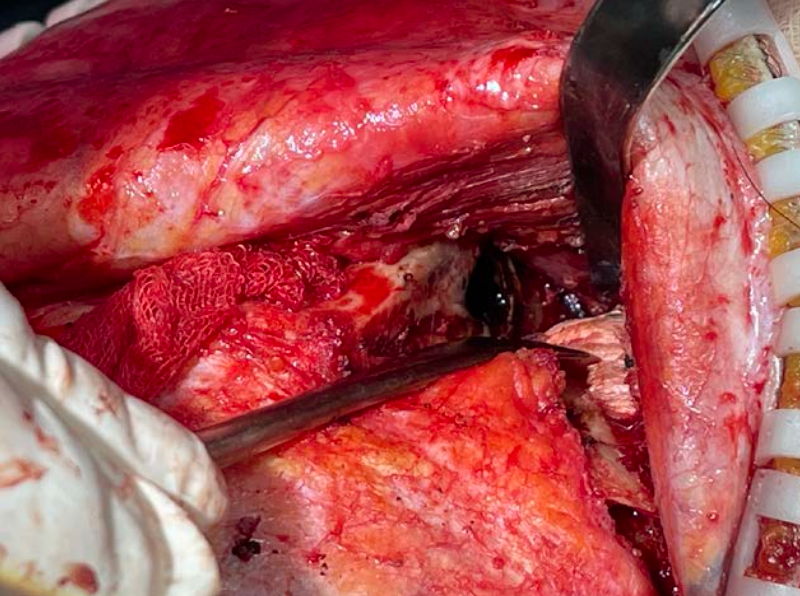
Fig. 2. The coronal approach increases exposure of the zygoma,
specifically the lateral orbital bone, allowing for a medial and
high osteotomy.
Midface Ptosis: The Defining Issue in Contemporary Zygoma Surgery
The Soft Tissue Problem
Modern craniofacial surgeons increasingly recognize that bone contouring cannot be separated from soft tissue behavior.
One of the most significant criticisms of traditional intraoral zygoma reduction is postoperative midface ptosis.
During intraoral dissection:
Zygomaticus major and minor attachments are disrupted
SMAS support weakens
Retaining ligaments are inadequately resuspended
Midface soft tissue loses structural support
The result is:
Cheek drooping
Nasolabial deepening
Premature aging appearance
Hollowed midface contour
The cited study found midface ptosis in 92% of intraoral cases.
Coronal Access Enables Midface Suspension
The coronal technique provides a significant reconstructive advantage by enabling simultaneous soft tissue resuspension. Through wide subperiosteal exposure, the surgeon can elevate and reposition midfacial soft tissues during closure, effectively integrating skeletal contouring with midface lifting and soft tissue redraping. Over long-term follow-up, this combined effect becomes particularly evident, as the procedure does not merely reduce facial width but also redefines the entire lateral midfacial unit.
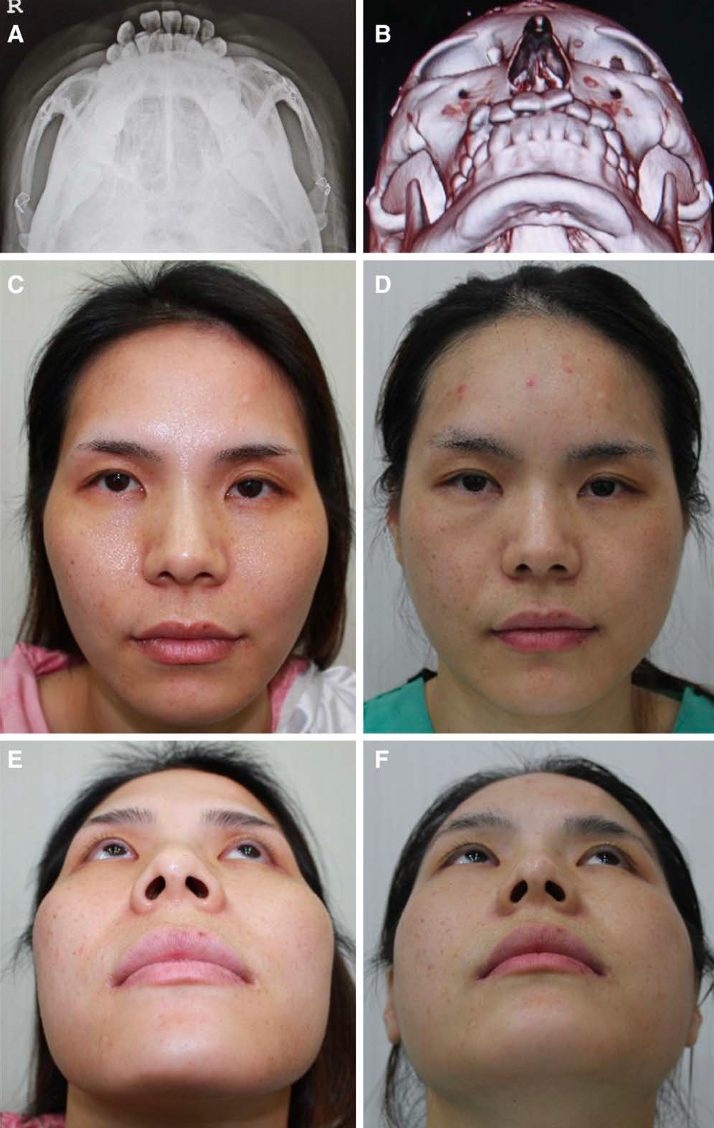
Fig. 3. The coronal approach provides access to the lateral orbital bone and the medial zygomatic complex for a favorable osteotomy. After the coronal approach, the postoperative X-ray (A) and the CT scan (B) images show a smooth, oval-shaped curvature of the zygomatic body. C, The preoperative frontal view of the patient’s face shows a wide and lateral flaring zygoma. D, The postoperative result showing an aesthetically favorable narrowing of the zygoma. The coronal approach not only decreases the width of the cheekbones but changes the curvature of the cheekbone from square-shaped and flaring (E) to a more oval shape (F).

Fig. 4. Midface soft tissue ptosis is a significant complication with intraoral zygoma reduction.
Compared with the preoperative midface (A), the postoperative result (B) shows soft tissue drooping,
which occurs when the zygomatic muscles and soft tissue are detached and not resuspended.
Why the Coronal Approach Is Returning in Advanced Facial Contouring A Shift Toward Structural Aesthetic Surgery
The renewed interest in the coronal approach for zygoma reduction reflects a broader paradigm shift in facial aesthetic surgery—from isolated dimensional reduction toward comprehensive structural facial reconstruction.
From Reduction-Based Surgery to Structural Rebalancing
Historically, zygoma reduction was primarily conceptualized as a volume-reduction procedure focused on decreasing bizygomatic width. Contemporary craniofacial practice, however, increasingly recognizes that optimal outcomes depend not on simple reduction, but on controlled three-dimensional repositioning and restoration of harmonious facial proportions.
Modern Surgical Priorities in Facial Contouring
Current high-level craniofacial and aesthetic surgeons increasingly emphasize:
Restoration of skeletal harmony across midfacial subunits
Preservation and reinforcement of dynamic soft tissue support mechanisms
Achievement of long-term structural stability under functional loading
Maintenance of native anatomical curvature and contour continuity
Refinement of three-dimensional facial aesthetics rather than planar reduction alone
Why the Coronal Approach Fits This Evolution
Within this framework, the coronal approach offers a biomechanical and technical advantage over limited-access techniques. Its superior exposure and fixation capacity allow for controlled repositioning of the zygomatic complex while simultaneously enabling management of adjacent soft tissue planes. This integrated approach aligns more closely with modern principles of structural facial contouring, where bone and soft tissue are treated as a unified aesthetic and functional unit rather than separate surgical targets.
Coronal Approach in Zygoma Reduction Surgery: Risk–Benefit Overview
Category | Item | Clinical Interpretation / Relevance |
Advantages | Superior surgical exposure | Enables full visualization of zygomatic body, arch, and frontozygomatic region, improving osteotomy precision |
Advantages | High three-dimensional control | Allows controlled medial, posterior, and superior repositioning of the zygoma |
Advantages | Rigid fixation capability | Facilitates stable fixation at lateral orbital rim, improving resistance to masticatory forces |
Advantages | Improved skeletal stability | Reduces risk of rotational instability and secondary malunion |
Advantages | Midface soft tissue management | Enables simultaneous elevation and redraping of midface soft tissues |
Advantages | Reduced contour unpredictability | More consistent achievement of smooth malar curvature and reduced angular deformity |
Disadvantages | Temporary alopecia | Reported in 81%; usually self-limiting within postoperative recovery period |
Disadvantages | Visible scalp scarring | Occurred in 28%; typically concealed within hair-bearing scalp but may be cosmetically relevant |
Disadvantages | Frontal branch neuropraxia | Occurred in 5%; generally temporary with spontaneous recovery |
Disadvantages | Hematoma | Low incidence (2%); requires routine postoperative monitoring |
Disadvantages | Longer operative time | Due to wide dissection and fixation requirements |
Disadvantages | Higher technical complexity | Steep learning curve compared to intraoral approaches |
Considerations | Intraoral approach trade-off | Avoids scalp morbidity but may compromise fixation stability and 3D control |
Considerations | Risk of malunion (intraoral) | Higher risk of rotational instability and inferior fixation strength |
Considerations | Midface ptosis risk (intraoral) | Greater likelihood due to soft tissue detachment without suspension capability |
Considerations | Revision surgery likelihood | Potentially higher in intraoral cases due to contour irregularities |
Overall interpretation | Risk–benefit balance | Coronal approach trades localized scalp morbidity for improved structural precision and long-term aesthetic stability |
The Future of Zygoma Reduction Surgery
As facial contouring becomes increasingly data-driven and outcome-focused, procedures will continue moving toward:
Structural preservation
Biomechanical optimization
Integrated soft tissue management
Long-term aesthetic stability
The coronal approach, once viewed as excessively invasive, is now being reevaluated as a sophisticated technique capable of delivering superior three-dimensional outcomes in appropriately selected patients.
For experienced craniofacial and aesthetic surgeons, the question is no longer whether coronal access is “too aggressive,” but whether limited-access approaches can consistently deliver equivalent long-term structural and aesthetic results.

Fig. 5. With the coronal approach, midface soft tissue and zygomatic muscle elevation can be achieved.
The preoperative photographs show significant flaring of the zygoma (A, C). The postoperative results
(B, D) taken 3 years after surgery demonstrate how the coronal zygoma reduction not only effectively
narrowed the cheekbones but also prevented an aged appearance with soft tissue suspension.
Conclusion
Modern zygoma reduction surgery has evolved far beyond simple narrowing of the lateral face. The coronal approach offers unparalleled exposure, superior fixation mechanics, and the ability to simultaneously manage soft tissue support — all essential components of contemporary craniofacial aesthetics.
While intraoral techniques remain useful in select cases, growing evidence suggests that coronal access may provide more stable, anatomically favorable, and aesthetically refined outcomes, particularly in patients requiring significant three-dimensional repositioning or long-term structural support.
For surgeons focused on durable facial harmony rather than short-term width reduction alone, coronal zygoma reduction represents a significant advancement in modern facial contouring surgery. Reference:
Seol, J.-Y., & Kim, K. K. (2023). The rationale of coronal approach to malar/zygoma reduction. PRS Global Open. https://doi.org/10.1097/GOX.0000000000005252
Stay informed on the latest advances in surgical techniques through insights from Korea’s expert faculty:
IFAAS Mini Fellowship (In-OR Observations)
Korean Advanced Facial Aesthetic Surgeries - Asian Rhinoplasty & Facial Bone Contouring

24-26 August, 2026 - Seoul, South Korea - [Register Now]
More Upcoming Global Events